Phone:
(701)814-6992
Physical address:
6296 Donnelly Plaza
Ratkeville, Bahamas.

Phone:
(701)814-6992
Physical address:
6296 Donnelly Plaza
Ratkeville, Bahamas.
This post contains affiliate links. If you buy something through one of them, we may earn a small commission at no extra cost to you — it helps keep Laika’s World running.
Winter changes the rules for your dog. The same walk you both enjoyed in October can chill a small dog, burn paws on salted sidewalks, or end with a lap of something poisonous in the garage. None of it needs special equipment or a big budget — it needs a few habits, started before the first real freeze. Here is what matters, in the order you will actually use it.
There is no single number that fits every dog. A Husky and a Whippet standing in the same 25°F morning are having two different experiences. The American Veterinary Medical Association’s cold-weather guidance says tolerance depends on size, coat, age, body fat, activity, and health — and Texas A&M’s veterinary college and Purdue University’s College of Veterinary Medicine put the landmarks in the same places.
Use the feels-like temperature, not the thermometer alone. Wind and a wet coat move the risk more than the air temperature does, and the Tufts cold-weather scale — developed by Gary Patronek, VMD, at Tufts University School of Veterinary Medicine — counts rain or sleet as a bigger risk factor than any single temperature drop.
| Feels-like temperature | Small, thin-coated, puppy, senior, or unwell dog | Large, thick-coated, healthy adult |
|---|---|---|
| Above 45°F (7°C) | Low risk if dry and out of the wind; rain can still chill a toy dog or puppy | Lowest risk; watch wet, windy days |
| 32–45°F (0–7°C) | Chills fast; Purdue advises bringing puppies and short-haired dogs in below 40°F | Lower risk while active and dry; don’t leave an unacclimated dog out long |
| 20–32°F (−7–0°C) | Short, supervised outings; brief bathroom breaks | No long periods outside; shorter, more frequent walks |
| Below 20°F (−7°C) | Brief bathroom breaks, then straight back in | Outdoor time about 30 minutes at most, less as it drops |
The AVMA advises against leaving any dog outside for a long period once it is below freezing, and Washington State University emergency veterinarian Dr. Linda Martin advises that most dogs — especially thinner-coated ones — should not be exposed to freezing temperatures for more than 10 to 15 minutes without access to a warmer space. Even Huskies can get frostbite when it is cold enough.
Watch the dog, not just the forecast. Shivering, slowing down, weakness, or hunting for a warm place to burrow means the walk is over. The dangerous sign is the opposite of what you would expect: a dog that stops shivering while it is still cold needs an emergency vet now — wrap it in warm blankets and go.
Paws take the worst of winter. Road salt and chemical de-icers — sodium chloride, calcium chloride, and magnesium chloride — are caustic to paw tissue. Direct contact dries pads, irritates the skin between the toes, and stings painfully if it gets into even a tiny crack. Calcium chloride is worse than plain salt: it generates heat as it dissolves, so it can cause thermal burns on top of chemical irritation. Ice balls form between the toes and cut into the skin, and at 0°F, frostbite can begin in as little as five minutes of continuous contact with frozen ground.
The fix is three habits, and the third one matters most:
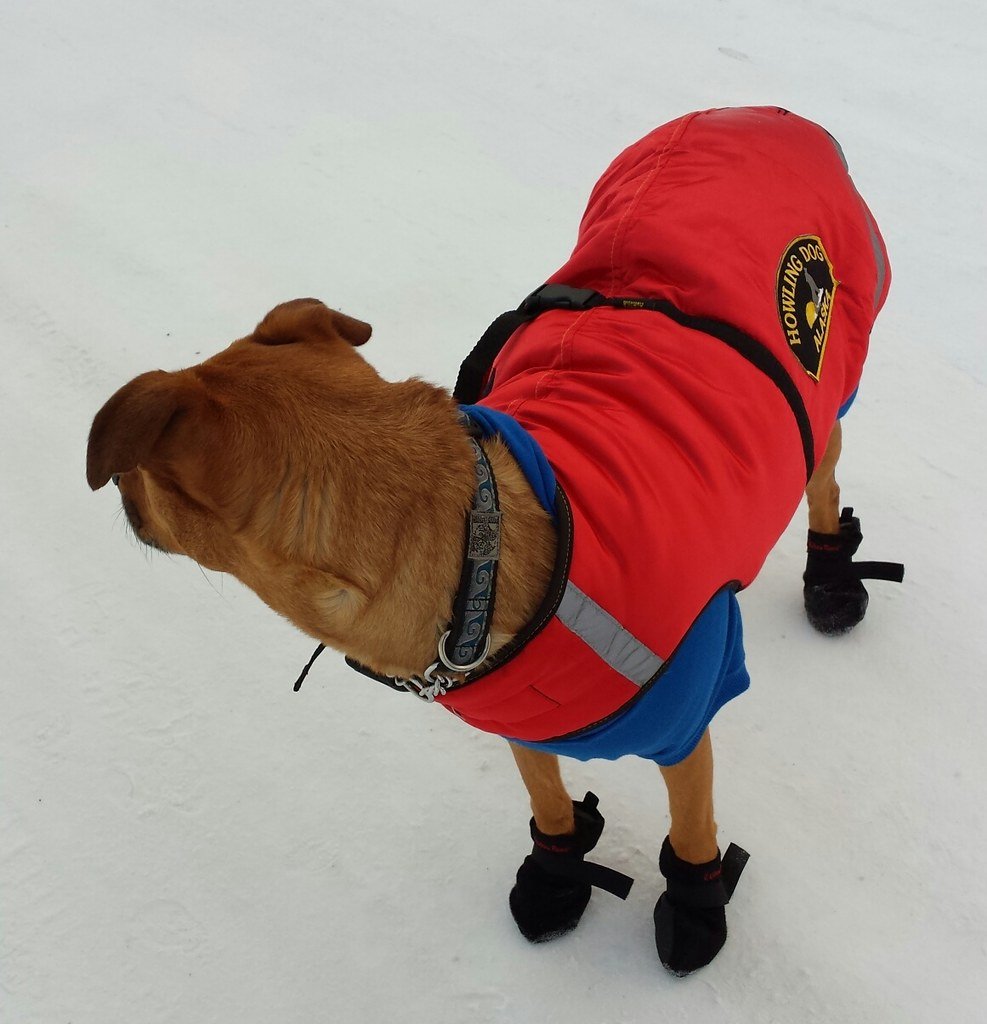
Protect before the walk. Paw wax or balm creates a thin barrier against salt, ice, and moisture — apply it 10 to 15 minutes before you go out, massaged into the pads and between the toes. Look for beeswax, carnauba wax, shea butter, and vitamin E. The sled-dog standby is Musher’s Secret paw wax (check price on Amazon: https://www.amazon.com/dp/B0002XIZXY), a food-grade wax blend that is safe if licked. Booties are the stronger shield and the best choice for heavily salted city sidewalks, dogs with existing paw injuries, or anything below 20°F. A useful rule of thumb: if a surface feels uncomfortably cold to your bare hand after five seconds, your dog needs booties on it. Start booties indoors two or three weeks before winter, with treats, so the first real walk in them is not also the first time wearing them.
Rinse the moment you get home. Salt left on paws keeps working after the walk is over, and dogs lick it off — which is how a paw problem becomes a stomach problem. Rinse with lukewarm water (never hot), check between the toes where salt and grit collect, and dry thoroughly. The American Kennel Club advises checking carefully between the toes after walks for exactly this reason. Trim the fur between the pads before winter starts; long tufts collect ice balls.
Know the warning signs. Redness, blistering, or raw skin between the toes, limping, or constant licking all mean the paws need a break from salted routes. Rinse well and rest them; if redness does not improve within a day or two, or the pads are bleeding, call your vet. And if your dog vomits, drinks excessively, or trembles after a walk on salted streets, call your vet right away — ingested ice melt can cause salt poisoning, and even “pet-safe” melt products cause vomiting and diarrhea if eaten.
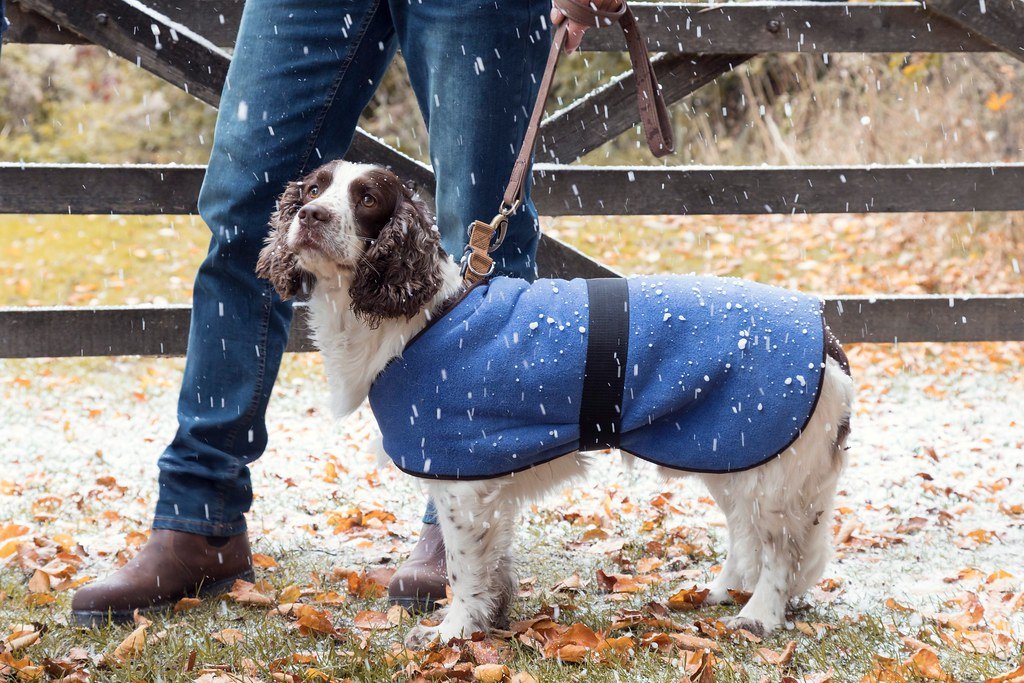
Most dogs do not need a coat. The ones that do are easy to spot: Whippets, Greyhounds, and other thin-coated breeds, puppies, seniors, dogs with very short hair, and any dog with a health condition that affects temperature regulation — the AVMA notes that pets with diabetes, heart disease, kidney disease, or hormonal conditions like Cushing’s disease have a harder time staying warm. A dog that shivers on a normal walk is telling you it needs a layer.
Two rules. First, fit matters more than fashion: the coat should cover from neck to tail base without restricting the legs, and it should be easy to get on and off. Second — and this one surprises people — a wet coat can make your dog colder than no coat at all. The AVMA is blunt about it: wet sweaters or coats can actually make your dog colder. If the coat gets soaked in rain or wet snow, take it off when you come inside and dry the dog, rather than leaving a damp layer on.
This is the section worth reading twice. Most car antifreeze is made with ethylene glycol, which tastes sweet — dogs lap up spills and puddles without a second thought. According to the Pet Poison Helpline, as little as a tablespoon can cause severe kidney failure in a dog. The Merck Veterinary Manual gives the minimum lethal dose of undiluted ethylene glycol as roughly 4.4 to 6.6 mL per kilogram of body weight in dogs.
The poisoning unfolds in three stages, and the middle one is the trap:
The antidote, fomepizole, only works early — Pet Poison Helpline says dogs need it within 8 to 12 hours of swallowing antifreeze. So the rule is simple: if your dog may have licked or drunk antifreeze, go to an emergency vet now and call a poison line on the way. Do not wait for signs. The ASPCA Animal Poison Control Center is at (888) 426-4435 and the Pet Poison Helpline at (855) 764-7661; both are open 24 hours a day and a consultation fee may apply.
Prevention is cheaper than treatment: clean up spills immediately, store coolant jugs where dogs cannot knock them over, and consider switching to a propylene-glycol antifreeze, which the ASPCA notes has a much wider safety margin. Watch for the less obvious sources too — a puddle under a parked car, a broken snow globe, or a winterized toilet.
Winter dries dogs out the same way it dries people out. Indoor heating plus cold air can leave skin flaky and coats dull. Regular brushing helps by distributing skin oils, and omega-3 fatty acids (from fish oil, with your vet’s okay on dose) support skin and coat — but if the itching is new, severe, or the skin is broken, that is a vet visit, not a supplement question. A pre-winter check-up is a good moment for exactly that conversation: our guide to finding the best veterinarian for your dog (https://laikasworld.com/how-to-find-the-best-veterinarian-for-your-dog/) covers what to ask at a first visit, and a senior dog’s winter plan — arthritis, shorter walks, a warmer sleeping spot — is worth raising at the same appointment.

Shorter walks also mean a bored dog, and a bored dog in winter invents its own entertainment. Swap some of the lost walk time for mental work indoors: puzzle feeders, snuffle mats, and training games. Our roundup of the top 7 dog toys for smart breeds (https://laikasworld.com/the-top-7-dog-toys-for-smart-breeds/) is a good starting list for enrichment toys that tire a dog out without leaving the living room — and a warm sleeping space matters more when the days are short, so if the bed is thin or on a cold floor, our heated beds guide (https://laikasworld.com/best-heated-dog-beds-and-self-warming-pads-for-winter-2026/) covers self-warming pads that need no plug.
Winter is not a season to keep your dog inside — most dogs love snow. It is a season to plan the walk before you open the door, and to come home to a warm, dry dog with clean paws. Do that, and the cold months are the easy ones.
Sources: AVMA, “Cold Weather Animal Safety” (https://www.avma.org/resources-tools/pet-owners/petcare/cold-weather-animal-safety); Texas A&M College of Veterinary Medicine and Purdue University College of Veterinary Medicine cold-tolerance guidance, via Rex Vet (https://www.rexvet.org/how-cold-is-too-cold-for-dogs-temperature-chart-by-size-and-coat); Pet Poison Helpline / ASPCA antifreeze poisoning timeline and hotlines, via Dogs Best Life (https://dogsbestlife.com/dog-health/antifreeze-poisoning-in-dogs/); Merck Veterinary Manual, Ethylene Glycol Toxicosis in Animals; American Kennel Club paw-care guidance, via Pets Addicters (https://petsaddicters.com/winter-paw-care-for-dogs/).